Raising a Caucasian Shepherd Puppy: Care From 2 to 4 Months

Updated: Sep 22
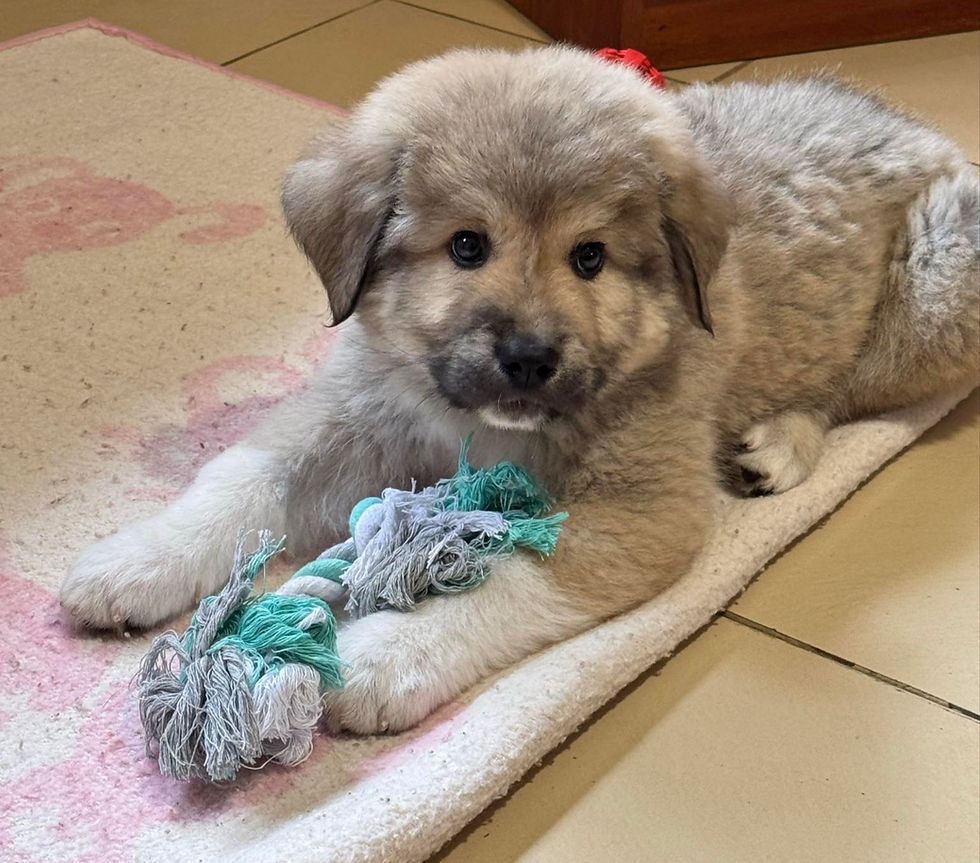
Caucasian Shepherd Puppy Care: The First Steps Toward a Confident, Balanced Dog
At two months old, a Caucasian Shepherd puppy is a tiny fluffy bundle of sweetness. All you want to do is cuddle it, kiss it and squeeze it.
And you should. A puppy needs closeness, calmness and the feeling that it already belongs to its new family. Good Caucasian Shepherd puppy care begins with trust, calmness and a strong bond from the very first days.
But from the very first day, there is one important thing we must never forget: this little fluffy baby will very soon become an enormous and extremely powerful dog.
The Caucasian Shepherd is an independent guardian breed. The FCI describes the breed as steady, self-confident, fearless, independent and devoted to its owner.
That is why, between two and four months of age, our goal is not to create a guard dog. The guarding instinct is already part of the breed and will develop naturally.
Our task is to build trust, calmness, good habits and a clear bond between the puppy and its owner.
Before the Puppy Arrives
You have chosen your puppy and are waiting for the day when you can finally bring it home. This time is not only for impatiently looking at photos. It is also the time to prepare your puppy’s new home.
A puppy usually leaves its mother and littermates at around eight weeks of age. It should be dewormed, microchipped, have a veterinary passport and have received the vaccinations appropriate for its age.
At eight weeks the vaccination course is usually not yet complete. Further vaccinations are still needed according to the schedule recommended by your veterinarian.
Prepare in advance
A quiet place for sleeping and resting, where the puppy can relax without being constantly disturbed.
Strong, easy-to-clean food and water bowls. Metal bowls are a practical choice and much harder to turn into a chew toy.
A collar and lead so the puppy can begin getting used to them while still young.
A soft grooming brush. At this age the purpose is not serious grooming, but learning that brushing is normal and pleasant.
A towel for paws and coat, especially if the dog will live in an apartment.
Safe chew toys made for puppies and large enough that they cannot be swallowed. Avoid leaving soft toys with stuffing, plastic eyes, buttons, squeakers or other detachable parts unsupervised.
Find a Veterinarian Before the Puppy Arrives
It is a good idea to choose a veterinarian in advance, preferably someone familiar with large and giant breeds. Tell them that you are expecting a Caucasian Shepherd puppy and how old it will be when it arrives.
During the first few days in its new home, arrange an initial examination and take all the documents you received from the breeder.
The veterinarian can check the puppy’s general condition, microchip and passport, review which vaccinations and deworming treatments have already been given, and plan the next stages of preventive care.
The breeder knows the breed and the individual puppy. The veterinarian follows its medical development. A responsible owner uses the knowledge of both.
A puppy showing diarrhoea, vomiting, severe lethargy, coughing, discharge from the nose or eyes, or other signs of illness should not be handed over to its new owners at that time. The breeder should first seek veterinary care, and the move should be postponed until the puppy is well.
The First Days — Security Comes Before Everything Else
Until only a few hours or days ago, the puppy lived with its mother, brothers and sisters. It knew their smell, their sounds and their presence. Suddenly everything is different: a new home, new people, new noises, no mother and no littermates.
The first days are therefore not the time to prove who is in charge, impose harsh discipline or begin guard training. They are the time to build security and trust.
Give the puppy plenty of affection and calmness, but introduce clear rules from the beginning.
Always ask yourself one simple question: Will I still be happy for my dog to do this when it is a fully grown Caucasian Shepherd?
Jumping on people, pulling clothes, biting hands during play and pushing through doors may look funny when the puppy is small and fluffy. A year later, they are not quite as funny.
Today it is funny. In a year, it may not be.
Puppies explore the world with their mouths. Chewing, stealing and pulling objects are normal puppy behaviours. Stay calm, remove inappropriate items without turning it into a fight, and redirect the puppy toward a safe chew toy. This is also the perfect age to begin teaching “Drop” and “Leave it”.
If the Caucasian Shepherd Will Live in a Yard
One of the biggest mistakes is to take home a two-month-old puppy, decide that a Caucasian Shepherd is an outdoor dog, give it a kennel and leave the baby alone outside from the very first day. Sometimes it is even tied to a chain.
Do not do this.
A two-month-old puppy has just been separated from its mother and littermates. It first needs to understand who its people are and where its new home is.
Even if it will eventually live mainly outdoors, during the first weeks it is better for the puppy to remain close to the family. During the day, gradually start taking it into the yard with you.
Let it sniff, explore, play, discover new smells and lie on the grass. You do not need to entertain the puppy constantly. Exploring the environment by itself is a major part of learning.
Make the yard safe first
Before the puppy’s first outing, carefully inspect the entire yard. Check the fence close to ground level. A small puppy may fit through a gap that an adult Caucasian Shepherd could never squeeze through.
If it gets out, it does not necessarily mean it is running away from you. Most likely, it simply saw something interesting on the other side.
Remove nails, screws, wire, sharp metal objects, construction debris, small objects, chemicals, tools and anything else that could be swallowed or cause an injury. Puppies put almost everything in their mouths, especially as teething begins.
No matter how carefully you inspect the yard, stay with the puppy during the first outings. A curious puppy has a remarkable ability to find exactly the one forgotten object you missed.
The puppy will show you when it starts to love the yard
Gradually, you will notice a change. After time outside, you decide it is time to go back indoors and the puppy does not want to come. It wants to keep sniffing, exploring or simply lie down in a favourite spot.
This is a good sign. The yard is no longer an unfamiliar place. It is becoming its home and familiar territory.
Some puppies reach this stage very quickly. Others need more time. There is no magical age or exact date. The transition should depend on the confidence and personality of the individual puppy.
Once the puppy knows the secure yard well, it can gradually be given more freedom. Many Caucasian Shepherds naturally choose a favourite place — under a tree in the shade, in a sunny spot or near the house — and are perfectly happy to spend long periods quietly outside.
A Chain Is Not a Way to Raise a Dog
Do not raise a Caucasian Shepherd permanently tied to a rope or chain.
A puppy needs movement, exploration, contact with people and the ability to choose whether to approach or move away. Permanent tethering removes those choices and may create intense frustration and reactive behaviour.
Imagine a dog tied within a two-metre radius. Someone approaches and it cannot move away. A person comes near its food and again it has nowhere to go. Another dog or person passes nearby and it is still trapped.
Over time, some dogs learn that the only way to increase distance is to bark, growl and lunge. Eventually the owner may find that they cannot safely approach their own dog.
If the dog cannot safely have access to the entire yard all the time because vehicles are moving, the gate is being opened or visitors are arriving, provide a secure and sufficiently spacious enclosure instead.
But an enclosure should not become the dog’s entire life either. Every day the dog still needs exercise, free movement, walks, training and contact with its family.
Restriction should be used for safety. It should never replace the dog’s life.
If the Caucasian Shepherd Will Live in an Apartment
There are habits that are much easier to establish while the puppy is small. One of them is cleaning after walks.
Come inside → go to the bathroom or designated area → wait → clean the paws → if necessary clean the belly and coat → dry the dog → then allow freedom in the home.
Puppies learn routines very quickly. Eventually, an adult dog can walk to its cleaning place by itself and wait patiently before being allowed into the rest of the apartment.
A full wash is not necessary every time. Sometimes a quick rinse or wipe is enough. The important thing is the habit: I come home, then I wait calmly while I am cleaned.
Feeding — Do Not Try to Raise the Biggest Puppy
The Caucasian Shepherd has enormous genetic potential for growth. There is no need to help it become bigger.
Choose a complete puppy food formulated specifically for the growth of large or giant breeds. At this age, puppies are usually fed three to four meals per day, with measured portions adjusted according to the individual puppy and its body condition.
Do not aim for the fastest possible weight gain. The ribs should be easy to feel beneath the skin without a thick layer of fat.
Do not add calcium on your own
This is especially important. Excess calcium can interfere with normal skeletal development in growing large and giant breed puppies.
If the puppy is eating a complete and balanced large or giant breed puppy food, do not randomly add calcium, vitamin D, bone meal or supplements marketed for bigger bones.
If you choose a home-prepared diet, it should be correctly balanced for a growing giant-breed puppy with the guidance of a veterinary nutrition professional.
The Food Bowl Should Mean Trust, Not Conflict
From puppyhood, the dog should learn that a person being near its food is not a threat.
With a calm puppy, while it is eating kibble, you can gently stroke around the muzzle and lightly move a few pieces of kibble with one finger near the area where it is eating. You are not taking the food away and you are not challenging the puppy. Your hand is simply present calmly near the bowl.
Gradually the puppy learns: This hand is not here to steal my food.
At the same time, teach “Drop”, “Leave it” and calm exchanges of objects for something valuable. The goal is that one day, if you need to remove something dangerous from the dog’s mouth or touch its food, it trusts you and does not interpret your action as a threat.
If the puppy is already freezing, stiffening its body, growling or guarding food, do not test it by putting your hand into the bowl. At that point, a different and more gradual approach is needed.
Movement and Joints — Free Movement, Not Sport
The puppy needs to move. That does not mean training it like an adult dog.
Free play, sniffing, exploring the environment and short calm walks are appropriate. There is no need to follow popular internet formulas such as five minutes per month of age. What matters more is the type and intensity of exercise.
Avoid prolonged forced exercise, jogging, running alongside a bicycle, repeated jumping, high obstacles, pulling or carrying weights and games that repeatedly make the puppy sprint and stop sharply. Slippery floors should also be limited.
Do not try to make a three-month-old Caucasian Shepherd muscular. At this age, the priorities are appropriate nutrition, healthy body condition, free movement and rest.
If the puppy limps, protects a limb, struggles to stand, appears painful or suddenly changes the way it walks, consult your veterinarian rather than simply waiting to see whether it passes.
Socialisation — Not Everyone Needs to Be a Friend
Socialisation does not mean that every person should pet the puppy, and it does not mean that every dog should play with it.
The goal is different: I see a stranger — calm. I see another dog — calm. I hear an unusual noise — calm. I arrive somewhere new — calm.
A Caucasian Shepherd does not need to be everybody’s friend. It needs to be confident and neutral toward the world around it.
Gradually introduce the puppy to different people, children under supervision, vehicles, everyday noises, different surfaces, veterinary clinics, car journeys and other normal parts of the life it will eventually lead.
Do not force strangers to pet the puppy. If it prefers to stay beside you and simply observe, that is also socialisation.
If it becomes frightened, do not drag it toward the thing it fears. Increase the distance and allow the puppy to calm down.
Contact with Other Dogs
Choose carefully. Good companions are calm, healthy, vaccinated and socially stable dogs.
A two-month-old Caucasian Shepherd does not need to be thrown into a dog park with ten unfamiliar dogs. One bad experience at this age may have more influence than ten meaningless encounters.
The goal is calm interaction, not a struggle for dominance.
Do Not Teach a Baby Puppy to Guard
Do not encourage “Guard!”, “Bark!” or “Get him!”. Do not praise the puppy for throwing itself against the fence, and do not teach it that every person beyond the gate is an enemy.
The Caucasian Shepherd does not need to be made into a guard dog. The guardian is already in its genetics.
At this age, it is far more important for the puppy to learn: When my person tells me that the situation is normal, I can relax.
At four months old, we do not want a dog that already guards. We want a dog that trusts its people.
Training — Clear Rules Without War
The Caucasian Shepherd is an independent breed. That does not mean it should be broken.
Physical punishment, rolling the dog onto its back, squeezing its muzzle or trying to show who is alpha are unnecessary.
From puppyhood, calmly begin building skills such as Come, Leave it, Drop, Stay, Place, calm lead walking, waiting at doors and accepting touch and handling calmly.
The most important thing is not for a three-month-old puppy to demonstrate ten commands. What matters more is that it learns to pay attention to you and to trust you.
Grooming — Start Before It Becomes Necessary
Do not wait for the first serious seasonal shed. Between two and four months, use a soft brush and groom the puppy briefly from time to time, even when the coat does not really need it.
At first, one or two minutes is enough. The purpose is not the coat. The purpose is the habit.
The Caucasian Shepherd has an enormous amount of undercoat, and when seasonal shedding begins, grooming becomes unavoidable. A dog accustomed to brushing from puppyhood can learn to enjoy it as pleasant attention.
With an adult dog that has never been accustomed to grooming, the process can easily become a battle — chasing the dog, biting the brush and trying to persuade a very large dog to stand still.
At the same time, teach the puppy to accept calm handling of its paws, ears, mouth, belly and the rest of its body.
Not every Caucasian Shepherd will necessarily need its nails clipped. In active outdoor dogs, nails often wear down naturally. But one day you may need to check for a thorn between the toes, a broken nail, a tick, a wound or something inside the mouth.
Sleep and Rest
A little Caucasian Shepherd may look like a tank and then fall asleep in the middle of the room five minutes later. Let it sleep.
Puppies need considerably more sleep than adult dogs. Do not constantly wake the puppy for play, and do not allow children or visitors to keep disturbing it.
An overtired puppy may start biting more, running around wildly and becoming unable to settle.
Sometimes the answer is not another game. The answer is sleep.
The Most Common Mistakes Between 2 and 4 Months
Overfeeding in an attempt to make the puppy huge.
Adding calcium and vitamins without a genuine need.
Too much physical exercise.
Putting a two-month-old puppy outside alone immediately after bringing it home.
Keeping it permanently chained.
Isolating it from people because a Caucasian Shepherd is supposed to guard.
The opposite extreme — forcing every stranger to pet it and every dog to play with it.
Encouraging barking and guarding behaviour while it is still a baby.
Physical punishment and fighting over who is in charge.
Inconsistent rules.
Allowing behaviours that will become unacceptable once the dog is fully grown.
Too little rest and too much stimulation.
The Most Important Thing
Between two and four months of age, we are not building a guard dog. We are building the foundation on which the adult Caucasian Shepherd will later develop.
We want a puppy that feels safe, trusts its family, calmly accepts the world around it, can be touched, groomed and examined, does not fear that people will steal its food, understands boundaries, has the freedom to be a puppy and gradually learns to look to its owner for guidance.
Love it like a baby, but raise it with the dog it will become in mind.
Comments