History of the Caucasian Shepherd Dog – Part 9 – Soviet Selection

Updated: Sep 22
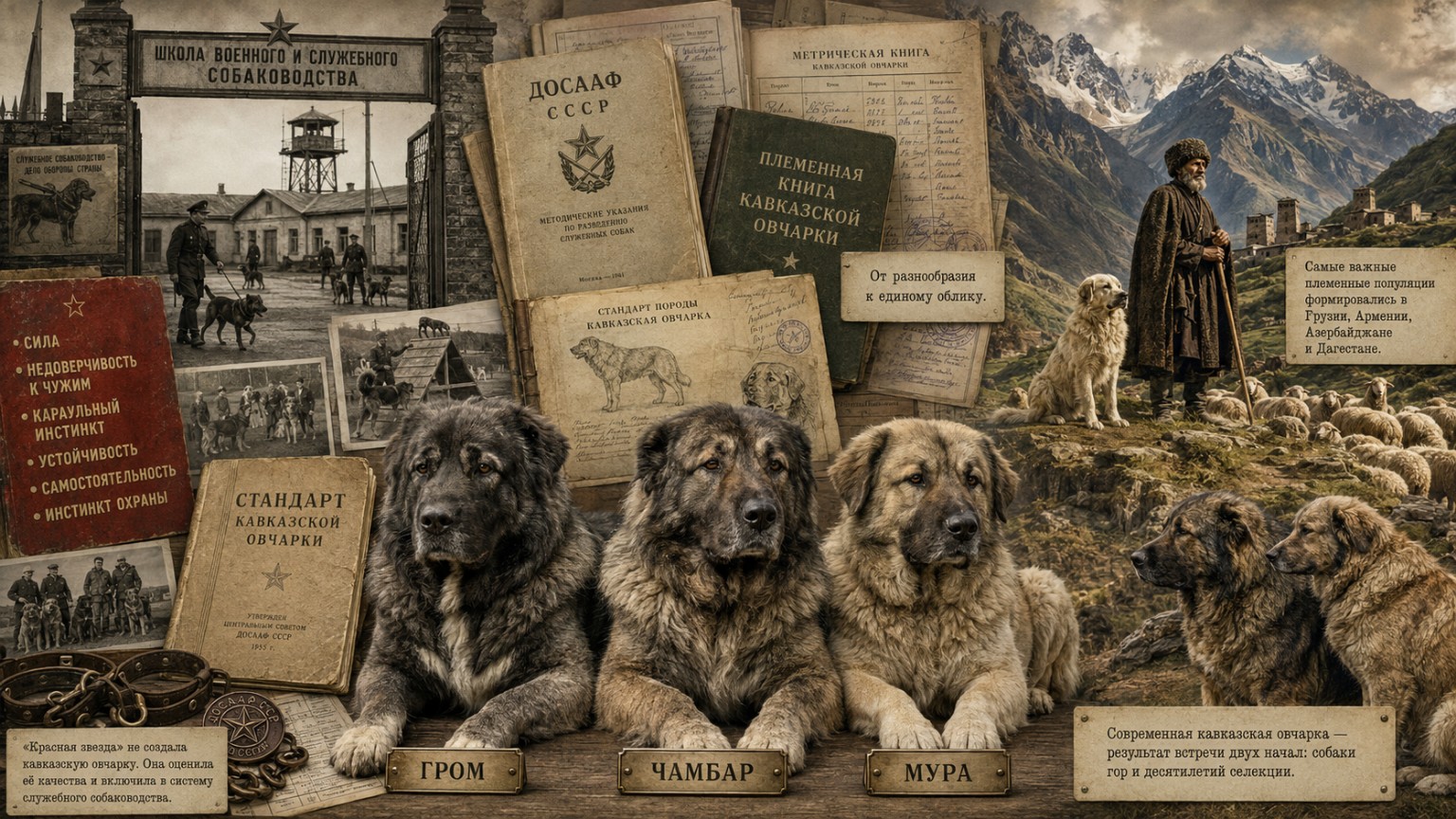
Between the Caucasus and “Red Star”
Two Paths
Up to this point, the history of the Caucasian Shepherd Dog has followed two paths. One remains in the mountains. There, the dogs continue to guard flocks, live according to local conditions, and differ from region to region. The other path becomes increasingly connected with the state. Dogs begin to enter schools, kennels, clubs, and exhibitions. They begin to be measured. Compared. Selected. And gradually, from a multitude of local dogs, a single breed with a more unified image begins to emerge.
“Red Star”
In 1924, the Central Experimental Kennel-School for Military and Sporting Dogs was established in Moscow. Four Caucasian Shepherd Dogs were recorded among its original dogs. Their purpose was clear: sentry duty. This is an important piece of evidence. From the very beginning of organized military dog breeding, the breed was already regarded as suitable for guarding. Later, the school became known by the name “Krasnaya Zvezda” – “Red Star.” It would go on to play a major role in Soviet cynology.
But here we must be precise. “Red Star” did not create the Caucasian Shepherd Dog. Nor did it create its ancient working qualities. Those qualities came from the Caucasus. The kennel used them. Evaluated them. And incorporated them into the state system of service-dog breeding.
Caucasian Shepherd Dogs at the School
By 1930, dogs from the school were already appearing at exhibitions. Among them were the Caucasian Shepherd Dogs Grom, Chambar, and Mura. This shows something very important. The breed was no longer only a working dog behind a fence or on sentry duty. It was beginning to be presented publicly. Evaluated. Compared with other representatives of the breed. And included in an organized breeding system. This is where the transition begins from a “good working dog” to a “suitable breeding animal.”
After the War
After the Second World War, Soviet cynology entered a new period. The state needed strong, large, and reliable service dogs. “Red Star” began active breeding work. Puppies and breeding animals from the kennel were distributed to service-dog clubs. Caucasian Shepherd Dogs were among them.
But the role of the breed was not limited to purebred breeding. Its qualities — strength, distrust of strangers, guarding instinct, and resilience — also began to be used as genetic material in the creation of new Soviet service breeds. One of these was the Moscow Watchdog. Here, the Caucasian Shepherd Dog was used not because someone wanted to change the breed itself, but because its qualities were already considered valuable and transferable.
But Where Was the Breed Itself Being Shaped?
Here, the story returns to the Caucasus. The most important breeding populations continued to be found in Georgia, Armenia, Azerbaijan, and Dagestan. It was there that Mazover described the different regional types. And it was there that we find dogs such as Kabo, Murtaza, Allash, Bosara, and Shugara.
These were not dogs created in a Moscow kennel. They came from local bloodlines. From collective farms. From pastoral regions. From state breeding farms. It was from these populations that Soviet cynology began to choose which qualities it wanted to preserve.
From Diversity to a Unified Image
During the 1950s, the picture was still highly diverse. Some dogs had longer coats. Others had shorter coats. Some were more massive. Others were leaner and more long-legged. Some were more squarely built. Others were more elongated in body. This was not a flaw. It was the natural result of different regions and different working conditions.
But the standard gradually began to change this. Over the following decades, Soviet standards became more precise and more measurable. Height requirements increased. Massive bone structure and powerful musculature were emphasized more strongly. Specific indices and restrictions appeared. The head, body, limbs, coat, and colours were described in greater detail. This is the moment when the standard stops merely describing the breed. It begins to direct it.
What Is Lost
When one common type is selected, part of the local diversity inevitably falls to the side. Lighter regional dogs begin to be regarded as less desirable. The more massive type gains an advantage. Differences between individual regions gradually lose importance. Less attention is paid to where the dog comes from. More attention is paid to whether it fits a unified breed image. This is the price of standardization. The breed becomes more recognizable. But part of its local diversity begins to fade.
What Remains of the Old Type
And yet, not everything disappears. The strong bone structure remains. The dense coat. Endurance. Distrust of strangers. Independence. The ability to make decisions without constant commands. And most importantly: the instinct to guard.
This is the thread connecting the mountain dog with the later Soviet breed. The standard changes the form. Selection makes the type more uniform. But the basic function remains recognizable.
Not One Hand, but an Entire System
It is easy to tell the history like this: someone creates a standard, someone chooses a type, someone shapes the breed. Reality is more complicated. The Caucasian Shepherd Dog is not the product of one person. Nor of one kennel. Nor of one book. It is the result of the meeting of several forces: nature, pastoral tradition, regional populations, state cynology, dog shows, studbooks, standards, and the selective choices of generations of breeders.
“Red Star” is part of this history. Mazover is part of it. DOSAAF is part of it. But the beginning is much older. It remains in the mountains. And when we look at the modern Caucasian Shepherd Dog today, we are looking at two dogs at once. One was shaped by centuries of work beside the flocks. The other was shaped by decades of organized selection. The modern breed is the result of the meeting between them.


Comments