History of the Caucasian Shepherd Dog – Part 11: When the Past Meets the Future

Updated: Sep 22
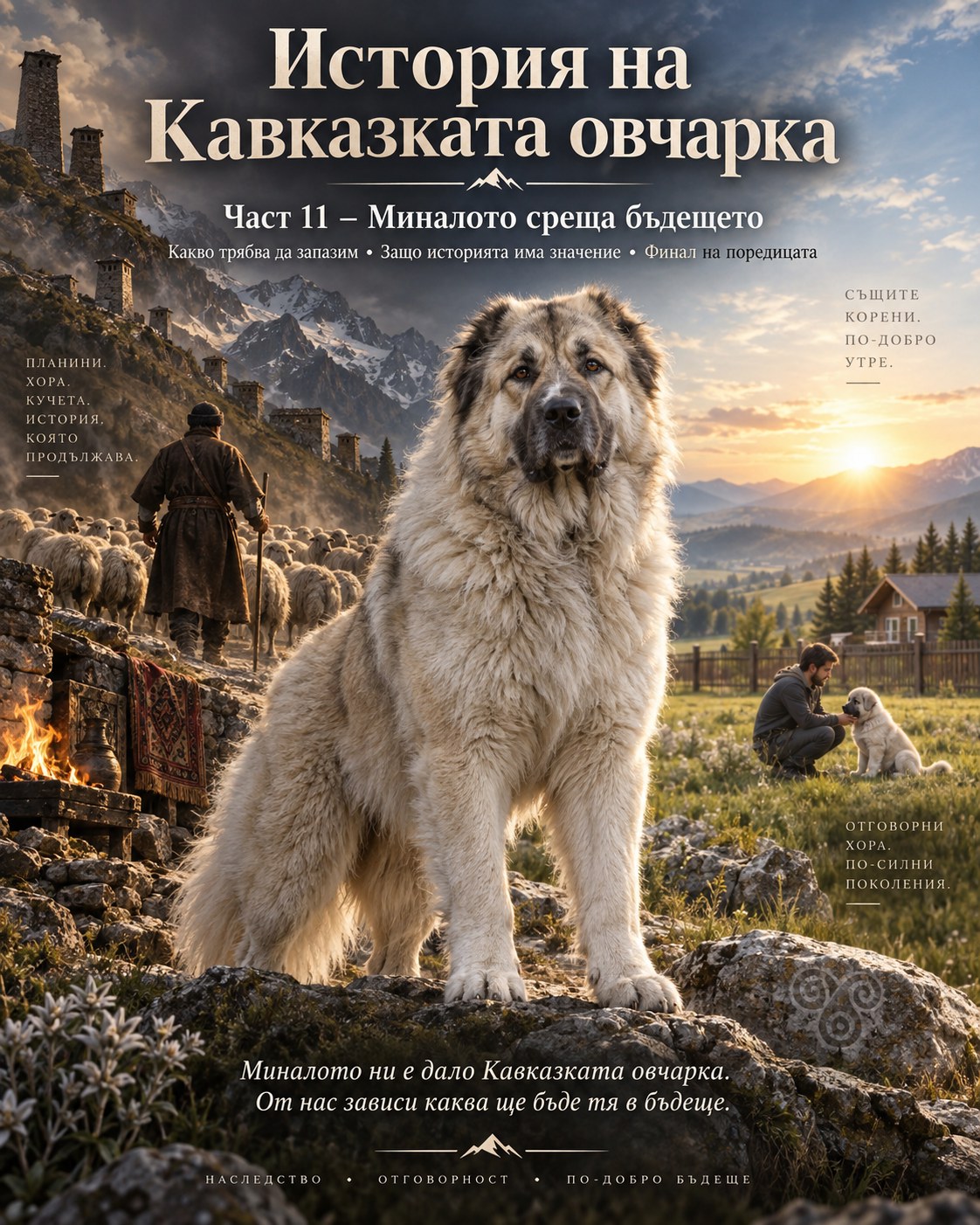
Over the course of ten parts, we have followed the path of the Caucasian Shepherd Dog through centuries, mountains, empires, wars, state kennels, standards and show rings.
We searched for its traces in old descriptions. We separated documents from legends. We explored the different dogs of the Caucasus, local types, service work, Soviet selection and the development of the modern breed.
But history does not end with the last old document.
It continues in every dog born today.
And this is exactly where the past meets the future.
What Have We Actually Inherited?
The Caucasian Shepherd Dog was not created as a decorative dog.
For generations, it was expected to live and work in difficult conditions, to observe, to make independent decisions and to protect what it considered its own.
A shepherd in the mountains could not stand beside the dog constantly, telling it what to do.
The dog had to decide for itself.
What was a threat. What could be ignored. When it was enough simply to watch. And when it was necessary to act.
This independence is one of the breed’s most valuable inheritances.
Today, it is sometimes called stubbornness.
But an independent dog is not necessarily a disobedient dog.
It was simply created to think.
We Should Not Preserve the Past Blindly
Preserving the breed does not mean trying to return to life as it was two hundred years ago.
The world has changed.
Most Caucasian Shepherd Dogs no longer live high in the mountains beside livestock. They live in yards, homes, families, farms, and sometimes even in urban environments.
That makes the responsibility of the modern breeder even greater.
It is not enough for a dog to look like a Caucasian Shepherd.
It must also be able to live in the world into which it is born.
Confident, but controllable. Protective, without reacting without reason. Suspicious of strangers when the situation calls for it, but without seeing the whole world as an enemy. Powerful, but stable.
Because without a stable temperament, the enormous physical strength of this breed loses its meaning.
What Must We Preserve?
Above all — character.
Not aggression.
Character.
The quiet confidence of a dog that does not need to prove its strength constantly.
The ability to observe. Independence. Territorial instinct. Attachment to its own people. Courage. A stable nervous system. And the ability to distinguish a real threat from ordinary daily life.
These are qualities that are difficult to measure with a tape measure in the show ring.
But they are exactly what make a Caucasian Shepherd Dog a Caucasian Shepherd Dog.
We Must Preserve Health as Well
The history of a breed should never be used as an excuse for its problems.
“They have always been like that” is not a sufficient answer.
Modern cynology and veterinary medicine give us possibilities that breeders in the past did not have.
We can examine hips and elbows. We can monitor hereditary problems. We can evaluate movement, structure, development and quality of life far more accurately.
Preserving the breed means using that knowledge.
Not breeding simply the biggest dog. Not the heaviest. Not the dog with the most coat.
But the healthy, functional dog that can move freely and fulfil the purpose for which the breed was developed.
True strength is not measured only in kilograms.
Size Is Not the History of the Breed
In recent decades, the image of the Caucasian Shepherd Dog has sometimes been reduced to one question:
How big is it?
But the people who lived with these dogs had much more important questions.
Can it guard? Can it endure? Does it have a good head — not only in shape, but in character? Does it know when to react? Can it move? Can it work?
A dog that is enormous but struggles to move is not an improvement of a working breed.
It is the loss of part of its heritage.
And What About Colour?
Throughout this series, we have also seen how easily one external feature can be turned into a legend.
White Caucasian Shepherd Dogs have existed for a long time.
Just as grey, sable, red, pied and other accepted colours have existed.
Colour is part of the dog’s appearance.
But it does not define its value as a Caucasian Shepherd.
A white dog is not less capable of working simply because it is white.
And it is not automatically more ancient or more valuable simply because of its colour.
Beneath the coat, the same essential inheritance must remain: health, temperament, structure and character.
Colour is the clothing.
The dog is much more than that.
Why Does History Matter?
Because without history, we can easily begin to believe myths.
A photograph is posted online without a date, and a few years later it becomes “proof”.
A story is passed from person to person and gradually begins to sound like a historical fact.
A modern trend is declared to be an “ancient tradition”.
And after some time, it becomes difficult to distinguish what was real from what we ourselves added later.
History does not give us every answer.
But it teaches us to ask the right questions.
Where does this claim come from? Is there a document? Is there a photograph with a known origin? Is there testimony from the period? Or are we simply repeating something because we have heard it many times?
This matters not only to people who love history.
It matters to the future of the breed.
Because Breeding Also Writes History
Every breeder makes choices.
Which dog should remain in breeding. What kind of temperament to look for. Which health tests to perform. Which qualities to place above fashion. What to pass on to the next generation.
One decision may seem small.
But when hundreds of breeders repeat the same decision generation after generation, the breed changes.
That is how it changed in the past.
And that is how it is changing today.
The future Caucasian Shepherd Dog will therefore not be defined only by standards and organisations.
It will also be defined by the choices made by the people who breed it.
The Past Should Not Become a Museum
We cannot, and should not, freeze a living breed in time.
But we can preserve its essence.
We can use modern veterinary medicine without losing functionality.
We can socialise our dogs without destroying their natural guarding instinct.
We can teach them to live in the modern world without turning an independent dog into a machine that simply obeys commands.
We can breed beautiful dogs without allowing beauty to become more important than health.
And we can love a particular type or colour without rewriting history to make it “more authentic” than everything else.
That is the balance.
And perhaps this will be the greatest challenge facing the breed in the decades ahead.
From the Mountains to the Future
Once, these dogs stood beside livestock in the Caucasus.
Later, some of them entered cities, military structures, kennels and show rings.
Standards appeared. Borders changed. States disappeared and new ones emerged. Breeding changed.
But one thing has remained remarkably recognisable.
When you see a truly confident Caucasian Shepherd quietly watching the world around it, there is still something of that old dog that once had to decide for itself what was happening beyond the light of the fire.
That cannot be measured with a ruler.
It cannot be seen in coat colour.
And it cannot be created simply by adding more kilograms.
It is character.
Final
This series began with the question: Where does the Caucasian Shepherd Dog come from?
But perhaps the more important question at the end is another one:
What kind of Caucasian Shepherd Dog do we want to leave behind for the future?
Healthy. Strong. Confident. Independent. Balanced. Capable of guarding. Capable of being part of a family.
A dog that carries its past, but still has a place in the future.
History is not only a story about what has already happened.
It is a warning about what we may lose.
And a reminder of what is worth preserving.
Centuries ago, the people of the Caucasus could not have known what the breed would look like today.
We do not know what it will look like a hundred years from now either.
But future generations will inherit what we leave behind.
And perhaps that is the most important part of the entire story.
The past gave us the Caucasian Shepherd Dog.
What it becomes in the future depends on us.


Comments